



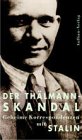
Hermann Weber, Bernhard H. Bayerlein. Der Thälmann-Skandal: Geheime Korrespondenzen mit Stalin. Berlin: Aufbau Verlag, 2003. 368 S. EUR 22.00 (broschiert), ISBN 978-3-351-02549-6.
Reviewed by David Barclay (Department of History, Kalamazoo College)
Published on H-German (February, 2005)
Documents on the Stalinization of German Communism
In 1927, John F. Wittorf, treasurer of the Wasserkante district of the Communist Party of Germany (KPD) in Hamburg, embezzled RM 1,550. That sum represented part of a larger transfer of money from the Soviet trade delegation in Rotterdam, a frequent conduit of funds to various Communist parties in Western Europe. The reasons behind Wittorf's embezzlement have always been unclear; personal consideration may not, in fact, have been his principal motivation. More importantly, his fellow Hamburg Communist--and chair of the entire KPD--Ernst Thälmann tried to cover up Wittorf's actions after learning about the affair. When Thälmann's cover-up was disclosed in the Social Democratic and left-Communist press in 1928, the KPD Central Committee voted unanimously to dismiss the party chair. A few days later, however, this decision was reversed, and "Teddy" Thälmann was back in his old post. How did this reversal happen? And what were the consequences of the whole affair? These are the questions that the editors of this documentary collection set out to resolve.
Bernhard H. Bayerlein, one of the editors of this collection, notes in one of the book's excellent introductory essays that the reversal of Thälmann's dismissal was, nominally, the result of actions by the Communist International (Comintern) and a change of heart within the Central Committee itself. Moreover, Thälmann had a powerful local base in Hamburg as well as in the Red Front Fighters' League (Roter Frontkämpferbund), with which he was closely associated; and those two power bases could not simply be ignored. But many observers at the time suspected that the decision to reinstate Thälmann came directly from the highest levels in Moscow; and the ninety documents contained in this volume prove beyond any doubt that Stalin and his principal lieutenants--among them V. M. Molotov and Dmitri Manuilsky--indeed intervened directly on behalf of the disgraced leader of the German party. Hermann Weber, another of the volume's editors, has devoted much of his distinguished career to the study of Stalinism and especially the processes of "Stalinization" within the KPD after the mid-1920s; and this book helps us understand concretely how those processes actually worked.
The documents included in the collection are dated between June 1927 and March 1929. Forty-five are housed in the Rossiiskii Gosudarstvennyi Arkhiv Sotsialno-Politicheskoi Istorii (Russian State Archive of Social-Political History, or RGASPI) in Moscow. Most notably, these include recently accessible but heretofore unpublished materials from the Comintern Archive and from the historical archive of the Soviet party's Central Committee. Of particular significance is Stalin's political correspondence located in the "Stalin-Fonds" (RGASPI 558), which forms the heart of this collection. The Moscow documents are supplemented by a rich selection of papers from several other archives, most notably the Stiftung Archiv der Parteien und Massenorganisationen der ehemaligen DDR im Bundesarchiv (SAPMO-BArch) in Berlin, a source that many historians have mined successfully in recent years.
Together, these primary materials sustain a narrative that Bayerlein breaks into three "cycles," beginning in late September 1928 with secret efforts by Stalin, Molotov, and the Comintern official Ossip Piatnitsky to rehabilitate Thälmann. Given the latter's close association with the Comintern's turn to the "left" at its recently concluded Sixth World Congress, Stalin regarded such a rehabilitation as a matter of the highest political priority. The second cycle, from October to December 1928, witnessed what Bayerlein calls a decisive "roll-back" in the Comintern. During this period the rehabilitation decision was implemented. As Stalin himself put it rather ominously in a letter to Thälmann on October 25, 1928, "Zuerst war es für uns sehr schwer zu verstehen, auf welche Weise neunzig Prozent der Mitglieder des ZK, die nicht zu den Rechten und Versöhnlern gerechnet werden können, einen Beschluß fassen konnten, und ihn veröffentlichen, der faktisch die Diskreditierung der Führung der KPD und vor allem des Gen. Thälmann bedeutete" (p. 222, Doc. 60). Bayerlein then shows, in his discussion of the third cycle of the Thälmann affair from December 1928 to March 1929, how the German party chief had become utterly dependent on Stalin's favor. Even more importantly, he shows how Thälmann's reinstatement was instrumentalized as part of Stalin's post-1928 campaign against the "rightists and conciliators" (Rechte und Versöhnler) to whom he had alluded in his letter to Thälmann.
Given the importance of these issues, many prominent Communists became embroiled in discussions of Thälmann, and they too are considered at length in the book. The reader will not be surprised to learn that Walter Ulbricht was in the Stalin-Thälmann camp and eagerly denounced the "conciliators" in his correspondence from Berlin to Moscow, while other Communists like Clara Zetkin and Jules Humbert-Droz were becoming deeply disillusioned with the implications of the Stalinization process for the future of the Marxist revolutionary project. The veteran radical Zetkin powerfully articulated her feelings in the book's final document, a letter from Moscow dated March 25, 1929 and addressed to the even more skeptical Humbert-Droz: "Ich werde mich voellig einsam und deplaziert fuehlen in dieser Körperschaft, die sich aus einem lebendigen, politischen Organismus in einen todten Mechanismus verwandelt hat, der an der einen Seite diese Befehle in russischer Sprache einschluckt und auf der anderen Seite diese Befehle in verschiedenen Sprachen ausspuckt, ein Mechanismus, der den gewaltigen welthistorischen Sinn und Gehalt der Russischen Revolution zu Spielvorschriften für Pickwickies-Klubs ummünzt" (p. 301, Doc. 90).
On the basis of this exceptionally interesting documentation, the editors convincingly argue that the Thaelmann scandal has to be regarded as a key event in the histories both of the KPD and of the Comintern. As Bernhard Bayerlein points out, Stalin himself felt no obligation to continue his support for Thälmann after the latter's arrest and incarceration by the Nazis. They suggest that Stalin might have been able to obtain Thälmann's release, but made no effort to do so. Thälmann himself wrote a series of plaintive letters to Stalin from prison, but the latter never replied; and Thälmann himself was murdered by the Nazis in 1944. Indeed, Bayerlein concludes, new evidence hints that Stalin might have consciously decided to leave Thälmann to his fate.
This volume is part of a series of documentary volumes (the "Archive des Kommunismus"), and it deserves to be widely read. Its portraits of Stalin, Ulbricht, and above all Thälmann are devastating; moreover, it provides indispensable background documentation for an understanding of the fateful evolution of German communism in the late 1920s.
If there is additional discussion of this review, you may access it through the network, at: https://networks.h-net.org/h-german.
Citation:
David Barclay. Review of Weber, Hermann; Bayerlein, Bernhard H., Der Thälmann-Skandal: Geheime Korrespondenzen mit Stalin.
H-German, H-Net Reviews.
February, 2005.
URL: http://www.h-net.org/reviews/showrev.php?id=10228
Copyright © 2005 by H-Net, all rights reserved. H-Net permits the redistribution and reprinting of this work for nonprofit, educational purposes, with full and accurate attribution to the author, web location, date of publication, originating list, and H-Net: Humanities & Social Sciences Online. For any other proposed use, contact the Reviews editorial staff at hbooks@mail.h-net.org.

