



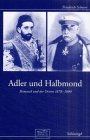
Friedrich Scherer. Adler und Halbmond: Bismarck und der Orient 1878-1890. Paderborn: Ferdinand SchÖ¶ningh, 2001. xvii + 571 pp. EUR 51.60 (cloth), ISBN 978-3-506-79221-1.
Reviewed by Hoi-eun Kim (Department of History, Texas A & M University)
Published on H-German (February, 2005)
Between Not-Too-Close and Not-Too-Far
Caveat Lector: from the equal-sized pictures of Bismarck and the Sultan Abdul Hamid II in the front cover of the book and from the very title of the book, one might mistakenly think the Turkish Sultan receives an equal amount of attention in this book. Though Friedrich Scherer quite convincingly proves that the Turkish Sultan indeed played a crucial role in Bismarck's grand formulation of foreign policy, in the final analysis this book deals with Bismarckian Orientpolitik during the last decade of his tenure, as the sub-title appropriately suggests. However, readers should rest assured: this monograph (originally a dissertation), is a German diplomatic history at its finest. Basing his argument on a meticulous analysis of documents primarily from the German Ministry of Foreign Affairs (Auswaertiges Amt), Scherer successfully maintains that, "from the beginning, the fate of the Ottoman Empire and that of Bismarck were tied inseparably" and "from the Bismarckian relation to Turkey, we can obtain an entire view of his foreign policy, which otherwise remains unknown or unfamiliar" (p. xii; p. xiii). Overall, tackling the ever-intriguing question of the continuity of foreign policy during the German Kaiserreich from the perspective of the origins and complex modifications of German-Turkish "friendship," this exhaustibly detailed book is a welcome addition to the historiography of the German Orientpolitik, though it is not without shortcomings.
To describe how and why German-Turkish rapport came about during the 1880s and in what ways such a rapport illuminates the Bismarckian Orientpolitik--and to a larger extent the guiding tenets of his foreign policy as a whole--Scherer has carefully constructed five chapters, three of which chronologically trace the trajectory of the Bismarckian Turkish and Orient policy within the domains of the European power politics. The final chapter thematically analyzes the main pillars of German-Turkish rapprochement from institutional, personal, and economic standpoints. The fourth chapter, which sits rather uncomfortably between the first three chronological chapters and the final thematic chapter--and probably for that reason is itself half-chronological, half-thematic--tries to unravel how the French and Italian colonial ambitions in the Ottoman Empire entangled the already multifarious Bismarckian matrix of Orientpolitik.
According to Scherer, Bismarck was a faithful follower of the traditional Prussian neutrality regarding the Orient, though he was also very eager to take advantage of the situational change in the Ottoman Empire in order to strengthen Prussian power, as was the case during the Crimean war. Without presuming any pro- or anti-Turkish stance, his attitude toward the country before 1871 was contingent upon the changing circumstances of the European alignment of powers, and he made clear that only when fluctuating conditions in the Ottoman Empire would threaten the Prussian and European status quo, would he then be interested in the Eastern Question (p. 22). However, the unification of Germany and the amelioration of relations with Austria and Russia, which ultimately led to the conclusion of the Dreikaiserbund in 1873, deprived Bismarck of this luxury of utilizing the Ottoman Empire from the standpoint of an onlooker. The underlying weakness of the Dreikaiserbund was the rivalry between Austria and Russia over the Balkan Peninsula, and Bismarck was to a certain extent forced to act as an "honest broker" between Austria, Russia, and Turkey so as to prevent any disruption in the status quo--which could potentially lead to an alliance between France and either Austria or Russia. However, at the Congress of Berlin following the Russo-Turkish War of 1877-78, Bismarck proved himself to be an "honest broker" only for the European (mainly for Austrian and British, but not necessarily for Russian) powers. Following the so-called Kissinger Diktat, which Scherer admits is a "central document of Bismarckian foreign policy," Bismarck tried to solve the Eastern Question at the cost of Turkish territorial and financial loss with a view to preventing any probable coalition of hostile powers against Germany (p. 40).
Considering this low-point of German-Turkish relations during the Congress of Berlin--where Bismarck did not even send an invitation to a Turkish emissary and essentially determined the Turkish territorial configuration by himself--the positive answer of Bismarck on June 4, 1880, to the request of the Sultan to dispatch German civil and military advisors was such a dramatic change that Scherer claims it was the Gruendungsurkunde of the later German-Turkish "friendship" and of Bismarckian Turkish policy, where Turkey was finally seen not merely as an object, but as a subject with its own agency (pp. 69-70). If so, why did Bismarck change his attitude toward Turkey so radically within the two years after the Congress of Berlin, and why did the Sultan try to improve his relations with Germany in the first place? According to Scherer, this was rather a fortuitous encounter of two totally different visions and objectives. On the one hand, the change of regime in Britain from Disraeli to Gladstone, an avowed advocate of anti-Turkish policies, escalated for the Sultan a feeling of urgency to seek out potential alliances. In Germany--whose relationship with Russia was deteriorating after the Congress of Berlin and who did not follow the British initiative against Turkey during the missionary Koelle crisis--the Sultan Abdul Hamid II found a partner that could help him both avoid encirclement by Russia and Britain and pursue financial and military reform. For Bismarck, on the other hand, the decision was mainly based on his anxiety toward Russia (p. 86). As the prospect of restoring the Dreikaiserbund with Russia appeared increasingly gloomy, Bismarck instead came to think that it would not be harmful to have a militarily strong Turkey as a friendly neighbor, though not as a formal alliance partner. However, this does not mean that Bismarck tried to act aggressively against Russia: rather, Scherer argues, this newfound friendship with Turkey was a gesture intended to put pressure on Russia so that she would eventually move closer to the Dreikaiserbund (p. 92).
By delineating the connection between the dispatch patterns and the changing political circumstances, Scherer continues to argue that Bismarck used his promise to send German advisors to Turkey also as leverage against Russian reluctance to join the Dreikaiserbund and later against the possible breakdown of the Dreikaiserbund at the end of 1881--although he tried hard to present this as a German "favor" to the eyes of the Sultan. After sending the first civil officer, Josef Wettendorf, as a financial advisor to the Sultan in July 1880, Bismarck strived hard to avoid sending German military advisors to Turkey. Especially after concluding the Dreikaiserbund in June 1881, there was no need for Bismarck to send military advisors, which could potentially have left a margin of doubt to Russia. However, when the Dreikaiserbund was put into danger by Austria's policy on Bosnia and Herzegovina in November 1881, Bismarck readily tried to strengthen his ties to Turkey by deciding to send the first group of German military officers in March 1882.
According to Scherer, Bismarck's move from the "not-too-close" stance to this "not-too-far" approach to Turkish relations in 1881 and 1882 was also based on the frustration of his initial and most desirable plan: that of persuading Britain and Turkey to conclude a formal alliance between them (p.163). To Bismarck's eyes, the restoration of an alliance between Britain and Turkey would serve the territorial and economic interests of both countries and would eventually lead to the stabilization of the Balkan Peninsula. This is because the alliance would ensure that Britain function as a patron of Turkey against Russian aggression, while simultaneously severing French-British cooperation. In short, it would serve German interests perfectly (p. 150). Following this line of argument, Bismarck also tried to persuade the Turkish special envoys to propose a formal alliance with Britain when they visited Berlin to propose an alliance with Germany in December 1881. When this scheme ended as a daydream, Bismarck came to think that he did need to keep Turkey as a potential partner against Russia and, based on this strategic consideration, he gave permission to send military advisors to Turkey (p.163).
If it is fair to say that Bismarck, at least to a certain extent, successfully maneuvered Turkey into his own diplomatic scheme, can we also claim that Bismarckian Turkish policy during 1879-1882 was beneficial to his ultimate goal of preserving the German and European status quo? Scherer grounds his resounding no to this question in two observations. First, contrary to Bismarck's strenuous effort to leave the peace of Germany outside the Eastern Question, the situation of Germany became increasingly entangled with European power politics surrounding the Balkan Peninsula, and the chance of war between Germany and Russia increased dramatically. Second, due to the crisis in Egypt, Bismarck's plan to urge Britain and Turkey to conclude an alliance stumbled miserably, and with that his plan to preserve Austrian interests against Russia in the Balkans also faltered (p. 176). If both these observations hold, then does this mean that Bismarck was fighting his version of the "war of illusion" by failing to recognize the loss of importance Turkey once enjoyed in British foreign policy, as Hajo Holborn maintains? Scherer answers no to this question as well by claiming that this is a teleological reading of history that projects the trends of the 1890s onto the 1880s; even though genuine socio-political changes that could have forced Britain to reevaluate the importance of Turkey might have occurred during the 1880s, the strategic importance of the Straits in her relation to Russia was enough to put Turkey on the top of the foreign policy priority list (p. 188).
Bismarck's Turkish policy, which was still in the process of formation and modification during the first half of 1880s, became crystallized in the form of a "Turkish cul-de-sac" during the Bulgarian Crisis of 1885-1888. When the crisis erupted in 1885, Bismarck's initial plan was again to keep the Dreikaiserbund intact through the sacrifice of Turkey (p. 232). He tried hard to prevent both Russia and Austria from advancing beyond the so-called "demarcation line," but the intensification of crisis and the ensuing conflict between Russia and Austria forced Bismarck to devise a moderate change to his Turkish policy: unlike his previous policy, which exploited Turkey as an instrument, a compensatory object or sporadically as a partner, his new strategy placed an ever-increasing emphasis on military deterrence and preparation. According to the "Turkish cul-de-sac" scheme Scherer describes, if a war broke out among European countries due to the Eastern Question, Russia would march toward the Straits through Bulgaria, and while Turkey and successively Britain fight against Russia, Austria would prepare to fight against Russia in the southern part of the Balkan Peninsula. In this ideal situation, Germany would not have to fight against Russia, but only, if necessary, against France (p. 246). However, the difficulty of persuading Britain, let alone Austria, proved to be a hurdle that could not be overcome. The "Turkish cul-de-sac" strategy was stuck in stalemate.
When his vision of the "Turkish cul-de-sac" did not seem to provide a readily available solution, according to Scherer, Bismarck again tried to firmly situate Russia on his side, and to his delight, this lead to the conclusion of the Reinsurance Treaty in June 1887. This signaled a refusal on the part of Bismarckian Turkish policy to recognize any possibility of a direct Turkish-German alliance, which Scherer claims Turkey had continued to see as a viable option for her Schaukelpolitik. With the Dual Alliance and the Reinsurance Treaty in his hand, Bismarck thought that he could survive the Bulgarian Crisis if he could persuade Britain to join an alliance with Italy and Austria. With the conclusion of the Orientdreibund in December 1887, it seemed as if Bismarck had gotten what he wanted, no matter how transitory it would end up being: he had contained the rivalry between Russia and Austria by getting the British to back up Austria with the help of Italy. This would make the Dual Alliance essentially superfluous, thus liberating Germany from the fear of a two-front war.
On the whole, Turkey seemed to exist for Bismarck throughout the 1880s only as a dispensable object. However, according to Scherer, Bismarck also genuinely believed that her not-too-far and not-too-close relationship with Germany was beneficial to Turkey as well, and he himself was working for the peace of Turkey. Unfortunately, this claim holds up only within the boundaries of German self-interest. Even when advocating the Turkish cause against British and Italian criticism during the crises in Armenia and Crete (and thereby protecting Turkish sovereignty) Bismarck was also plotting to channel the Russian Black Sea fleets against Turkey in order to entice Britain into protecting her, thus activating the ever-desirable British-Russian confrontation in the Balkans (p. 319).
After providing a very detailed description of the (almost day-to-day) operation of Bismarckian Turkish and Orient policy, Scherer moves on, in his thematic (and most fascinating) chapter, to discuss the main pillars of this "superficial" German-Turkish rapprochement, as well as how it was related to German imperialism and economic interests. First, Scherer assesses the role of the Sultan. In his view, Sultan Abdul Hamid II was the principal propagator and symbol of Turkish affinity to Germany, but he was at the same time an obstructer of internal and military reform--the very reason for which he had tried to invite German military and civil advisors. Was it then a German imperialistic impulse that propelled Germany's affinity to Turkey? Clearly Germany was the only great power which did not have a direct imperialist ambition in the Ottoman Empire, and in terms of economic interests as well, Germany had an advantage by not having significant colonialist, mercantile, and financial interests in Turkey. Bismarck was also very conscious not to proliferate (though not preventing, as was the case of the Deutsche Bank's direct investment in railway) any serious German economic interests in Turkey that might essentially circumscribe his room to maneuver.
By sacrificing any economic and personal interests to the cause of German political security, Bismarck seems to have achieved an international order that, true to his image as "a sorcerer's apprentice," did not break up at least until his resignation in 1890. In assessing Bismarck's legacy after 1890, however, Scherer's indictment is rather ambivalent. On the one hand, he clearly gives more emphasis to the positive aspect of the Bismarckian system. Against the contention that Bismarck's decision to send military advisors to Turkey stifled German-Russian relations at the outbreak of World War I, Scherer explicitly recognizes that, although there might have been a chance that the dispatch of military advisors could develop with its own dynamism, in actuality this never occurred and Russia in fact did not care at all about it (p. 547). In a similar vein, against the assertion that Bismarck's approval of the acquisition of the Anatolian railroad concession through the consortium under the direction of the Deutsche Bank aggravated the German-British relations, Scherer claims that though it was not dissuasive enough, Bismarck discouraged the participation of the German bank (p. 548). Finally, against the statement that Bismarck created not a system for a perpetual peace in Europe but a system based on "balanced antagonism," Scherer claims that such an insight can be obtained only after the catastrophic event forces us to rethink the past. On the other hand, however, Scherer does not fail to mention that there certainly are important aspects that support the idea of an unswerving continuity between Bismarck and Wilhelm II, and in that respect foreshadows the eventual failure of the Bismarckian Orientpolitik. According to Scherer, Wilhelm II "in principle only followed the path which Bismarck paved but did not intend to finish. Through the alliances with Austria and Bulgaria as well as the friendship with Turkey, the track bound for the self-assured and latent anti-Russian Orientpolitik was already there" (p. 327). Coupled with the new Kaiser's strong interest in Turkey, this "new" Orientpolitik was well on the way, when the "Turkish cul-de-sac" strategy and the Reinsurance Treaty went by the board.
Certainly it is extremely difficult to find shortcomings in such an immensely well-researched book, but nonetheless there are a few points at which fair criticism is due. First of all, the limitation on the scope of research brought about by relying solely on German archival materials and the lack of Turkish source materials is hard to ignore, and this is especially true when we consider that the German-Turkish relationship was, in essence, a reciprocal relation, not a unilateral one with Bismarck sitting at the driver's seat. Of course, Scherer puts forth enormous effort to fill in the gap by relying on secondary sources to reconstruct the circumstances surrounding the Schaukelpolitik of the Turkish Sultan, but the restless movement and calculation of Turkey among European powers leaves an impression that it might actually be Abdul Hamid II, not Bismarck, who was sitting in the driver's seat in this diplomatic quagmire. For instance, the pro-Russia and pro-France stance taken by Turkey during the fall of 1886 clearly shows that the Sultan also did not hesitate to exercise his own initiative to steer the stream to his favor. This, in turn, suggests that a transnational history, one whose analysis transcends the nation-state boundary, would provide a more accurate description of diplomatic relations at the time. Scherer's work is clearly on this track but by and large it does not surpass the confines of a traditional diplomatic history. In relation to this first criticism, the lack of detailed description of the sojourn of the Turkish officers in Germany, whose official stay began in April 1884, is a rather glaring omission (p. 174). This could have served as a very interesting and fruitful addition were it coupled with the section on German advisors in the final chapter. Also, the work could have devoted some attention to the German residents in Constantinople whose numbers were hovering at over a thousand in 1886 (p. 376). These minor quibbles notwithstanding, this is a valuable book that contributes significantly to the historiography of Bismarckian foreign policy.
If there is additional discussion of this review, you may access it through the network, at: https://networks.h-net.org/h-german.
Citation:
Hoi-eun Kim. Review of Scherer, Friedrich, Adler und Halbmond: Bismarck und der Orient 1878-1890.
H-German, H-Net Reviews.
February, 2005.
URL: http://www.h-net.org/reviews/showrev.php?id=10205
Copyright © 2005 by H-Net, all rights reserved. H-Net permits the redistribution and reprinting of this work for nonprofit, educational purposes, with full and accurate attribution to the author, web location, date of publication, originating list, and H-Net: Humanities & Social Sciences Online. For any other proposed use, contact the Reviews editorial staff at hbooks@mail.h-net.org.

