



Dominic D. P. Johnson. Overconfidence and War: The Havoc and Glory of Positive Illusions. Cambridge: Harvard University Press, 2004. 288 pp. $26.95 (cloth), ISBN 978-0-674-01576-0.
Reviewed by Jonathan D. Beard (National Association of Science Writers)
Published on H-War (January, 2005)
Pervasive Optimism
"Hurrah, boys, we've got them!" were reportedly George Armstrong Custer's final words of encouragement to his troopers at the Battle of the Little Big Horn. Dominic Johnson cites them as an extreme example of overconfidence in war. But Johnson is not much interested in battlefield vainglory. His carefully argued study of the role of positive illusions in nations' decisions to go to war--or not--is focused at the top: dictators, prime ministers, cabinets and general staffs. He makes a good case for overconfidence being a major factor in these decisions.
Johnson, a political scientist and member of the Society of Fellows at Princeton University, creates a template for analyzing the role of positive illusions among decision makers, and then applies it to five recent situations: World War I; the Munich Crisis of 1938; the Cuban Missile Crisis of 1962; the choice by five American presidents to continue engagement in Vietnam; and, finally, the decision to invade Iraq in 2003. He chooses these both for their differences--two represent decisions to start wars, two are times when wars were averted, and one represents a repeated commitment to action over decades--and for what they have in common. All occurred within the last 100 years, all but Iraq have been intensively studied by historians, and for most of them we have both public sources in the form of government announcements and press reports, as well as such private sources as diaries and tapes.
Overconfidence begins with a short examination of optimism's roots in human evolution and psychology. It is both useful and pervasive, Johnson argues. During much of human history, people have been prey, and during the last few thousand years, warfare has been a significant factory in our lives. Optimism and (unwarranted) confidence aid survival under such conditions. Psychological testing has found, over and over, that almost everyone rates themselves as above average, and they underestimate their chances of getting sick or having accidents. Leaders, he suggests, are almost sure to incarnate both optimism and high self-esteem. Confidence combined with faulty information frequently leads to miscalculation.
The decision to go to war in 1914 illustrates all this beautifully, Johnson maintains. The leaders of Germany, Russia, France, Britain and even Turkey all announced that the war would be quick and easy--and that they would win. All the evidence he provides from private sources indicates these leaders believed this in their hearts. And one of the reasons many gave is a hallmark of positive illusions: the moral factor. The superiority of their race, culture etc. would overcome any material or numerical advantages of their enemies. As for military commanders, they had carefully prepared plans, and were confident the plans would succeed--as if their foes would simply fall into their hands. Of course, all these leaders were dead wrong. The Great War proved longer and more destructive than anyone had imagined. Even the one power which did not expect an easy victory--Austro-Hungary--never imagined defeat and its own dissolution.
If positive illusions were responsible (in part) for the enthusiastic decisions to go to war in 1914, what about crises which did not flame into fighting? Johnson takes up two such crises as his next studies by looking at Munich in 1938 and the Cuban missile crisis of 1962. He argues that confidence levels were lower, and not shared by all parties, in the negotiations in Munich, and during the Cuban Missile crisis. Hitler was confident he could bluff his opponents--but not that his armed forces could beat France and Britain. Chamberlain was overly optimistic about Hitler's honesty and ambitions, but these misperceptions faded during the crisis. In 1962, Khrushchev had illusions about his ability to install missiles without the United States either detecting them or reacting firmly, but he had no illusions about the relative military power of the USSR. Neither he nor Kennedy harbored any illusions about surviving a nuclear war.
Johnson's scheme does not work so well for Vietnam. The five American presidents involved, each of whom enlarged the war in one way or another, must, he asserts, have believed in the possibility of ultimate victory, because they continued to sacrifice money, then lives, trying. Yet it is not clear they were confident, any of them. One thing his study emphasizes is how often these presidents sent experts--military, intelligence, academic--to Vietnam on study missions. In almost every case these people came back with reports saying the war could not be won. Yet no one wanted to be the first American president to lose a war.
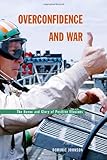
The photo on the jacket of Overconfidence is of George W. Bush, taken aboard the USS Abraham Lincoln in May 2003, when he announced that "Major combat operations in Iraq have ended." Johnson writes that overconfidence led both Saddam Hussein and Bush to war. It seems ridiculous to think that Saddam Hussein would have believed he could beat the United States, but, Johnson points out, he had miscalculated in invading Iran in 1980, and Kuwait in 1990, yet emerged still in power. And, critical to one of Johnson's main assumptions, his information was faulty, because no one in Iraq would have dared to question his confidence. For the USA, Johnson asserts Bush's advisers correctly believed they could overthrow Saddam Hussein, but badly underestimated the challenges of nation-building. He seems to have a point. As for information, Bush may have chosen what to listen to, and what to hear. Even in an open, democratic society, this can be a problem for leaders.
Overconfidence is clearly written, with good endnotes. Johnson is thorough, and I think he makes his case for the role of overconfidence in decisions to go to war. Whether military historians--who are generally interested in the process of warmaking, rather than the reasons wars start--will be interested, is another question.
If there is additional discussion of this review, you may access it through the network, at: https://networks.h-net.org/h-war.
Citation:
Jonathan D. Beard. Review of Johnson, Dominic D. P., Overconfidence and War: The Havoc and Glory of Positive Illusions.
H-War, H-Net Reviews.
January, 2005.
URL: http://www.h-net.org/reviews/showrev.php?id=10167
Copyright © 2005 by H-Net, all rights reserved. H-Net permits the redistribution and reprinting of this work for nonprofit, educational purposes, with full and accurate attribution to the author, web location, date of publication, originating list, and H-Net: Humanities & Social Sciences Online. For any other proposed use, contact the Reviews editorial staff at hbooks@mail.h-net.org.

