



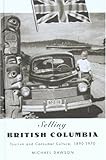
Michael Dawson. Selling British Columbia: Tourism and Consumer Culture, 1890-1970. Vancouver and Toronto: UBC Press, 2004. xii + 288 pp. $35.95 (paper), ISBN 978-0-7748-1055-5; $104.95 (cloth), ISBN 978-0-7748-1054-8.
Reviewed by Catherine Cocks (School of American Research)
Published on H-Canada (January, 2005)
The Evergreen Playground
Both scholars of Canadian history and those interested in twentieth-century tourism should read this book. In tracing the development of tourism in British Columbia from 1890 to 1970, author Michael Dawson argues that a "tourist trade," intended to attract potential settlers and industrial developers, became a "tourist industry" in which the money spent by tourists is its own reward, and visitors are expected to stay just long enough to spend a good deal. In other words, tourism was transformed in the twentieth century by "its incorporation into a burgeoning culture of consumption" (p. 5). This periodization historicizes pleasure travel without falling into problematic distinctions opposing "travel" to "tourism" or equating the increase in the number of leisure travelers with democratization. Although its focus and substance are regional, the book illuminates the larger national and international relationships within which western Canadian tourism took shape. As a result, it offers insights into regional rivalries and alliances, uneven economic development within "advanced" nations, and the meaning of state involvement in promoting tourism.
In the introduction, Dawson situates his study, and tourism generally, within the history of the consumer culture in Canada. Pleasure travel, he points out, "is as much about purchasing goods and services as it is about obtaining 'authentic' experiences" (p. 10). Swimming against the tide of cultural-history studies, he critiques the emphasis on tourist experiences and instead focuses on the role of businessmen and government officials in developing tourism in British Columbia. The overwhelming emphasis on reception and consumer agency in research on consumer culture, he argues, tends to obscure businessmen's and politicians' ability to shape possibilities and desirabilities. As he warns readers, those looking for a history of the tourist experience in British Columbia, the industry's environmental impact, the growing role of corporations, or the views of tourist workers or indigenous people will not find it here (p. 12). One would hope that such disappointed readers will rush to the nearest archive to pursue the work that Selling British Columbia so admirably begins.
The book is organized both chronologically and geographically, moving forward in time and outward in space from Victoria and Vancouver to British Columbia to the Pacific Northwest to Canada as a whole, with the United States perpetually looming as a source of tourists and competing tourist attractions. Initial promotion efforts between 1890 and 1920 were inseparable from civic boosterism in Victoria and Vancouver. A lack of good roads and accommodations long made smaller, inland communities unattractive or inaccessible to travelers, and efforts to obtain public funding to build and improve the roads played a key role in selling tourism promotion as a boon for the province, not merely its coastal cities. Just as business leaders like Victoria's Herbert Cuthbert saw tourists as potential investors as well as sightseers, travel writers combined an anti-modern longing for an escape from the mundane with a keen eye for exploitable resources. Sublime scenery advertised industrial opportunity rather than being endangered by it. In making this point, as in his decision to focus on business and government, Dawson provides the seeds of a much-needed critique of the emphasis on anti-modernism as the motive of much early-twentieth-century leisure travel.[1]
By the 1920s, tourist promoters began to portray tourists not so much as potential settlers as the source of immediate economic benefit. Tourism advocates in Victoria, which lost its industrial and commercial enterprises to Vancouver in the early twentieth century, claimed that "tourism was the 'only industry that cannot be taken away'" (p. 84) from the city. The modern view of tourists as people who come, see, spend, and leave emerges as a central sign of the elaboration of a consumer culture. This new understanding of pleasure travel had a significant impact on how promoters advertised the province: statistical bulletins gave way to heavily illustrated brochures seeking to enumerate the province's scenic attractions and opportunities for play. Scenery and leisure increasingly stood in opposition to resource extraction and industry.
Partly in response to the success of destinations like California, New Mexico, and Quebec in marketing their ethno-historical distinctiveness, promoters also sought to heighten the Britishness of British Columbia so that "playing golf and drinking tea" (p. 114), as well as buying linens, woolens, and other distinctively "British" products, enacted the British Columbia experience. Like other scholars, Dawson demonstrates that tourism had an important part in making "cultural diversity" a desideratum of modern life by commodifying ethnic difference.[2]
As he details the changing rationale for tourist development, Dawson also discusses two related phenomena: fluctuating efforts to organize regional, cross-border groups and the growing role of government, first at the municipal, then the provincial and national levels. Early government assistance was spare and sporadic. Promoters worked as hard to encourage it as they did to promote pleasure travel itself. Local and regional business groups and government agencies came and went in a welter of acronyms, the changeability of which nicely symbolizes the shifting rationales, players, and strategies at work. Overall, despite the resistance of the British Columbia provincial government in the 1920s and 1930s, the trend was toward a more sustained role for government agencies in coordinating provincial, regional, and national tourism campaigns.
Tourism promoters in British Columbia also sought alliances across the border with similar groups in the U.S. states Washington and Oregon. A central fact for the British Columbia tourist trade was that most of the tourists were Americans. Moreover, southern California was the model and market leader in North American tourism for much of the twentieth century. The Pacific Northwest Tourist Association (PNTA), founded in 1916 to pool resources and coordinate campaigns to lure pleasure travelers north, died of a lack of government appropriations in 1923. Dawson links its demise to the emergence of the new understanding of tourism for its own sake. But one may wonder, given the growing role of the provincial and national government in organizing and regulating tourism, whether the cross-border nature of the PNTA hampered its efforts. Tourism promoters seem to have abandoned any thought of international regional alliances after 1923.
By the 1930s, tourist promoters gained significant provincial and national government support, partly by portraying tourism as a relatively cheap, free-enterprise-oriented solution to the Great Depression. Tourism promised to export the costs of developing the province's infrastructure and attractions while employing its people and sustaining its businesses. The late-twentieth-century notion that tourism could develop underdeveloped nations without great economic resources or extensive industrialization clearly has its roots in the uneven development and economic vicissitudes of the so-called "first" world. The Canadian Travel Bureau (CTB) was established in the early 1930s, bringing greater coordination and sustained effort to national tourism policy and promotion. A few years later, the British Columbia Government Travel Bureau (BCGTB) came into being. Both agencies signaled the widespread acceptance of the new model of tourism among business leaders and government officials. Both intended to expand and rationalize the industry.
In his discussion of the 1930s and 1940s, the author argues that much greater continuity exists between the interwar period and the post-World War II spending boom than historians have previously argued. During the Great Depression people retrenched economically less than one might expect, and advertisers put ever-greater faith in promotion in the absence of buying power. Despite stringent wartime rationing and patriotic exhortations to conserve gasoline and rubber, tourist promoters continued to advertise during the war, with the tacit consent of the government. Wartime advertising emphasized patriotic conservation but also encouraged people to take local trips and plan for future journeys. Indeed, tourist promoters insisted that tourism would have "stabilizing effects upon civilian morale, individual health, and national unity" (p. 116) as well as bringing in much-needed U.S. currency. The idea that leisure was critical for national well-being was hardly unique to Canada and, indeed, was a theme central to both democratic and fascist states in the mid-twentieth century.[3]
In British Columbia, the war enabled businessmen and officials in the BCGTB to consolidate the industry, coordinating advertising campaigns and regulating businesses like auto courts and campgrounds. In the postwar period, market research became increasingly important in shaping both advertising and service provision, and university curricula were reshaped to provide the needed expertise. Such research contributed to different emphases in provincial advertising, notably growing attention to female travelers, and not just as smiling wives watching their husbands fish or hunt but successful hunters and fishers themselves. Dawson explains the "new emphasis on heterosexuality and the female consumer" (p. 148) as a response to greater competition among the provinces and with U.S. resorts, as well as a more generalized response to anxieties about women and waged work. In addition to discussing the new prominence of young women in advertising images, Dawson notes the limited role that elite women played in promoting tourism, largely by reorienting their longstanding role in civic beautification and public relations.
By the late 1940s, tourism had become what it remains today, a source of income in and of itself, rather than the catalyst for other kinds of development, at least for the major cities. Rural communities retained the older view that pleasure travelers would stimulate agriculture and industry (p. 192). The importance of tourism to the local economy led business leaders to try to teach the populace to be better hosts by means of an uneasy mix of persuasion and surveillance. It is not clear why the locals needed teaching; Dawson offers little evidence of resentment or resistance to tourism other than the strategic presence of the unemployed at major sites during the 1930s. Tensions between locals, neo-locals, and visitors, a rising cost of living or greater congestion, municipal struggles over the allocation of resources to serve visitors rather than locals do not seem to have arisen in British Columbia before 1970 as they did--and do--elsewhere.[4]
This strong study opens up several important questions. Take, for example, the role of Native people. Notably, British Columbians deliberately obscured Native culture and arts for much of the twentieth century, in contrast to the pervasive commercialization of Native crafts for tourists in the Southwestern United States and Mexico during the same period. Yet by 1967, promoters offered a 100-foot totem pole as the province's contribution to the celebration of Canada's centennial (pp. 212-213), and today the iconic arts of Pacific Northwest First Nations crowd the shelves of museum shops and tourist traps. Tourism has become a critical economic and cultural resource for many aboriginal peoples as well as an easy means for whites to atone for past racism. Knowing how this sea change occurred in British Columbia could shed light on a global phenomenon.
Moreover, Dawson offers a fascinating but all too brief discussion of the importance of gender and heterosexuality in shaping post-World War II tourist promotion. Attributing the greater, if transient, emphasis on young women to competition and the inherent allure of pretty girls, he discusses only in passing the many fascinating images in this well-illustrated volume. The young woman standing shoulder to shoulder with a large, dead fish, her legs spread and her fishing pole upright (after p. 140) demands far more explanation than "sex sells" or even "post-war anxiety about women's roles." Although the author's emphasis on the business and politics of tourism is a welcome counter to the usual focus on imagery and experience, the latter are central to tourism, and advertising content, placement, and circulation can provide critical evidence.
Finally, what did it mean that most of the tourists in British Columbia were Americans? (Perhaps it is appropriate to reveal here that not only am I an American, I'm an American who has drunk tea and bought woolens in British Columbia.) On pages 79-80, Dawson invokes James Scott's Seeing Like a State to portray government tourism research and programs as surveillance and people-management techniques, although for the most part his account of the politics of tourism does not foreground this leftist critique of the modern state. But the reference raises a very interesting question: what happens when the state is counting and classifying not citizens but visitors--by definition, casual visitors who generally (though not always) leave after a few days? If states exercise power by subjecting citizens to various forms of enumeration and classification, what do they do with foreign tourists? The most obvious answer is, of course, customs and immigration regulation, and historians are beginning to write the history of passports and other strategies for controlling mobility. The creation of special tourist enclaves ("resorts" or "tourist bubbles") in poor nations or neighborhoods or non-democratic states operates to contain and classify tourists and citizens alike.[5] But the foreign tourist may escape many of the programs and methods of governance aimed at citizens, perhaps especially when the money he or she brings is critically necessary. Further, Canada attracts many Americans in part because of the absence of elaborate border controls and the perception that Canada is not that different from the United States. If one takes Scott--and Dawson citing Scott--seriously, twentieth-century tourism offers an opportunity to think about globalization in very concrete terms.
Notes
[1]. Among works offering anti-modernism as a major motivation for tourists, see Leah Dilworth, Imagining Indians in the Southwest: Persistent Visions of a Primitive Past (Washington, D.C.: Smithsonian Institution Press, 1996); Catherine Cocks, Doing the Town: The Rise of Urban Tourism in the United States (Berkeley: University of California Press, 2001), chapter 6. Dean MacCannell's classic The Tourist encouraged this trend by casting tourists as alienated moderns; see The Tourist: A New Theory of the Leisure Class (New York: Schocken Books, 1976).
[2]. See, for example, Cocks, Doing the Town, chapter 6; Dilworth, Imagining Indians; James Buzard, "Culture for Export: Tourism and Autoethnography in Postwar Britain," in Being Elsewhere: Tourism, Consumer Culture, and Identity in Modern Europe and North America, ed. Shelley Baranowski and Ellen Furlough (Ann Arbor: University of Michigan Press, 2001), pp. 299-319; and Rudy Koshar, "'What Ought to Be Seen': Tourists' Guidebooks and National Identities in Modern Germany and Europe," Journal of Contemporary History 33, no. 3 (July 1998): pp. 323-340.
[3]. See, for example, Shelley Baranowski, Strength through Joy: Consumerism and Mass Tourism in the Third Reich (Cambridge: Cambridge University Press, 2004); and Michael Berkowitz, "A New Deal for Leisure: Making Mass Tourism during the Great Depression," in Being Elsewhere, pp. 185-212.
[4]. See, for example, Hal K. Rothman, Devil's Bargains: Tourism in the Twentieth-Century American West (Lawrence: University Press of Kansas, 1998), especially chapters 9 and 10; Briavel Holcomb, "Marketing Cities for Tourism," in The Tourist City, ed. Dennis R. Judd and Susan S. Fainstein (New Haven: Yale University Press, 1999), pp. 54-70.
[5]. On the passport, see Radhika Viyas Mongia, "Race, Nationality, Mobility: A History of the Passport," in After the Imperial Turn: Thinking With and Through the Nation, ed. Antoinette Burton (Durham: Duke University Press, 2003), pp. 196-214; for "tourist bubble," see Dennis R. Judd, "Constructing a Tourist Bubble," in The Tourist City, pp. 35-53.
If there is additional discussion of this review, you may access it through the network, at: https://networks.h-net.org/h-canada.
Citation:
Catherine Cocks. Review of Dawson, Michael, Selling British Columbia: Tourism and Consumer Culture, 1890-1970.
H-Canada, H-Net Reviews.
January, 2005.
URL: http://www.h-net.org/reviews/showrev.php?id=10148
Copyright © 2005 by H-Net, all rights reserved. H-Net permits the redistribution and reprinting of this work for nonprofit, educational purposes, with full and accurate attribution to the author, web location, date of publication, originating list, and H-Net: Humanities & Social Sciences Online. For any other proposed use, contact the Reviews editorial staff at hbooks@mail.h-net.org.

