



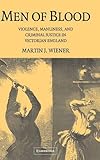
Martin Joel Wiener. Men of Blood: Violence Manliness and Criminal Justice in Victorian England. Cambridge: Cambridge University Press, 2004. XVI + 296 S. $70.00 (cloth), ISBN 978-0-521-83198-7.
Reviewed by Marjorie Levine-Clark (Department of History, University of Colorado at Denver)
Published on H-Law (January, 2005)
Men's Violence and Victorian Values
Martin Wiener skillfully utilizes the tools of legal history, gender history, and cultural history to explore the ways that men's violence increasingly clashed with claims to respectability in Victorian culture, and the ways this clash played out before the courts. While he devotes a chapter to male-on-male violence, Wiener is primarily interested in examining the changing responses to men's violence toward women, especially with regard to domestic homicide. This is a story of the triumph of Victorian values in the legal and cultural reshaping of masculinity: from a society that encouraged male violence for a variety of purposes (beatings to discipline wives, dueling for honor, and street fighting for sport, to name a few), grew a society where civility was embodied in a revulsion toward violence and an effort to contain it. Respectability was to be expressed through moderation and self-restraint, and men of all classes had to re-fashion themselves to this new model of non-violent manliness or face the increasingly harsh legal consequences.
While the Victorian domestic ideal limited the scope of respectable behavior for women, it also set up new standards for men, not the least of which was the better treatment and protection of women. This version of chivalry is not new to students of Victorian gender assumptions, but Wiener's unpacking of domestic ideology for its legal implications with regard to men's violence toward women is a refreshing look at an old story. For Wiener, "the protection of women came to pose the question of the 'reconstruction' of men, and the criminal justice system became a site of intense cultural contestation over the proper roles of and relations between the sexes" (p. 6). In studying cases of men who sexually assaulted or killed their wives, Wiener demonstrates the ways the legal process helped to shape this new more civilized ideal of manly behavior through stronger charges and more severe sentences.
But the story is not so simple. As Wiener argues, while the basic narrative of the triumph of manly civility held true in Victorian culture, it was complicated by resistances. Historically, men's violence toward women, and especially their wives, had been justified by women's "bad" behavior. Wiener devotes two chapters to "Bad Wives," and the ways that appeals to wives' drunkenness, sauciness, and infidelity became less persuasive to justify a husband's "chastisement" that led to a wife's death. The figure of the scold provided much comic as well as domestic relief for pre-Victorians, but seemingly became less funny in the nineteenth century. Yet, while judges and the Home Office lost patience with men behaving badly toward their wives, the (male) public and press continued to have sympathy for the man who killed his nagging, drunken, or adulterous wife. As Wiener points out, judges and other legal officials were increasingly unwilling to be lenient with men who claimed to be punishing women (even women of the lower classes) who transgressed the feminine ideal. In this way, men were even more hemmed in by gender ideals than were women: they could hang for their transgressions. The acceptable bounds of "provocation" for men's violence became more and more limited for officials, but the public continued to grant men some slack.
Wiener also points to a resistance in the conflict between an emphasis on individual culpability and a critique of harsh punishment. Juries were consistently hesitant to put forward convictions that would result in the death penalty or other severe sentences. Judges, however, were less squeamish, and even for findings of manslaughter, would send a man away for life. Sometimes this was a matter of taste: the level of perceived brutality of a man's violence could significantly alter the type of sentence a judge--or jury--was willing to hand out. Here, as in other areas, Wiener is careful to point to the class biases of those defining violence, as brutality was assumed of working-class men, and especially condemned in those considered more refined.
The press, the public, and the Home Office in different ways became more central actors in the legal drama, as the time between sentence and execution was extended, thus calling into play petitions for reprieve which necessitated Home Office interventions. Wiener provides fascinating discussions of the willingness of judges and juries more frequently to bring a verdict of murder, as long as there was a possibility for reprieve from execution. Wiener also shows that while the tendency in the Victorian era was towards the reduction of violent crime, this was not the case with regard to men's violence against women. The power of domestic ideology might have produced a greater willingness to prosecute and punish more severely men who used violence towards their wives, but it did not necessarily curb the violence itself.
Wiener draws his argument from an impressive collection of materials. In addition to newspaper accounts of legal proceedings, Wiener has mined the assizes courts and the Home Office, both the public records and the private correspondence of those involved in decision-making concerning male violence. He has constructed a database of "several thousand Victorian criminal cases, including virtually every case of spouse murder that went to trial, and a large sample of spouse manslaughter, and other homicide and rape cases" (p. xiii). Like much good cultural history, Wiener's work is an analysis of the relationships between discourse and experience, between ideologies and practice. Wiener examines the ways that material changes such as the increasing presence of police and coroners' inquiries, the growth of the press, and legal shifts away from execution, combined with greater ideological pressures for respectability to produce a culture in which crimes against property took a back seat for the first time to crimes against the person. Wiener nicely entwines legal and cultural norms, exploring the rifts between law and public sentiment, and how each acted upon the other.
Wiener is very good at examining the multiple factors impinging on this changing response to male violence. However there are several places where cultural contexts get visited too quickly: for example, the impact of the women's movement or the role of the imperial "other" on conceptions of violence. Frances Power Cobbe's famous contestation of "wife torture" in the home is passed over in a single paragraph,[1] and Wiener gives little attention to the impact of women themselves on changing the acceptance of male violence. This is a story between men. Unlike studies, such as Angus McLaren's Prescription of Murder, which stresses women's own efforts to root out male violence [2], Wiener's book portrays women as victims, passive beings who are either protected by the law or subject to male brutality. With regard to the imperial context, Wiener is provocative in pointing to the contradiction between control of violence at home and the acceptance of violence abroad, yet much more could be said about this almost double vision of domesticated versus imperial masculinity. Indeed, Wiener touches on tensions present in imperial masculinity alone, as violence for control vied with the need to set a civilized model for colonial others.
Additionally, in a book about masculinity, Wiener says surprisingly little about the ways manliness was understood in Victorian culture outside of its relationship to violence. I would have appreciated a wider contextualization of violence and masculinity, and in what other realms the increasing culture of civility impacted male behavior. Moreover, although arguing for changes in the masculine ideal, Wiener on some levels illustrates continuity: the very fact that the public and the press resisted the judicial cracking down on male violence (especially in relation to the chastisement of "bad wives") could be read as evidence of cultural continuities rather than a move to the construction of the "reasonable man."
Overall, Men of Blood is a compelling study which will find enthusiastic readers interested in legal history, gender history, and Victorian studies more broadly. In addition to persuasive analysis, Wiener tells a good story full of disturbing cases, complicating even further the shattered ideal of Victorian domestic harmony.
Notes
[1]. Frances Power Cobbe, "Wife-Torture in England," Contemporary Review 32 (April 1878): 55-87.
[2]. Angus McLaren, A Prescription for Murder: The Victorian Serial Killings of Dr. Thomas Neill Cream (Chicago: University of Chicago Press, 1995).
If there is additional discussion of this review, you may access it through the network, at: https://networks.h-net.org/h-law.
Citation:
Marjorie Levine-Clark. Review of Wiener, Martin Joel, Men of Blood: Violence Manliness and Criminal Justice in Victorian England.
H-Law, H-Net Reviews.
January, 2005.
URL: http://www.h-net.org/reviews/showrev.php?id=10141
Copyright © 2005 by H-Net, all rights reserved. H-Net permits the redistribution and reprinting of this work for nonprofit, educational purposes, with full and accurate attribution to the author, web location, date of publication, originating list, and H-Net: Humanities & Social Sciences Online. For any other proposed use, contact the Reviews editorial staff at hbooks@mail.h-net.org.

