



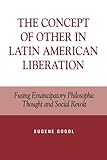
Eugene Walker Gogol. The Concept of Other in Latin American Liberation: Fusing Emancipatory Philosophic Thought and Social Revolt. Lanham: Lexington Books, 2002. xii + 385 pp. $110.00 (cloth), ISBN 978-0-7391-0330-2; $32.95 (paper), ISBN 978-0-7391-0331-9.
Reviewed by Marc Becker (Division of Social Science, Truman State University)
Published on H-LatAm (December, 2004)
Latin American Liberation
This is a masterful study that interweaves Hegel's dialectic of negativity, Marx's humanism, and subjectivity in a strand of Latin American revolutionary thought together with case studies of social movements to create a Latin American philosophy of liberation. It proposes "a conceptual view of social transformation, an overarching vision of the necessary new beginning that could serve as a pole of attraction for Latin America's masses" (p. 8). It is an ambitious project in which Gogol is eager to engage intellectual trends of both the academic and organic kinds in order to chart a path toward liberation.
The book is divided into four sections, with the first part laying out "The Philosophical Foundations of the Other" beginning with Hegel and how his thought has been engaged in Latin America. Gogol attempts "to look in two directions simultaneously: (1) a view of Hegel with Latin American eyes; (2) a view of Latin America with the eyes of the Hegelian dialectic" (p. 52). From there he moves through a summary of Frantz Fanon and a drive for post-colonial and new humanistic models, Octavio Paz with a particular emphasis on what Gogol considers to be his earlier and more perceptive writings, Leopoldo Zea and problems of identity, Augusto Salazar Bondy and questions of dependency, Anibal Quijano on modernity and utopia, Enrique Dussel's interpretations of the other, and ending with a critique of Arturo Andrés Roig's use of Hegel.
Gogol then moves to reintroduce Marx into debates over Latin American liberation. He argues that current emancipatory movements such as the Zapatistas and MST have provided the initiative to re-envision liberation (pp. 89-90). He traces this back through the twentieth century into a grounding of what he sees as two of the most significant interpretations of Marx for the Latin American context: José Carlos Mariátegui and Gustavo Gutiérrez. Mariátegui contributed three unique aspects to Latin America liberation: a study of the Indigenous Question and land tenure, his revolutionary journalism, and his attempts to form labor and socialist organizations (p. 100). In particular, Mariátegui's writings on race and class are important advances in applying Marx to Latin America. Gutiérrez, of course, is best known as a founder of liberation theology. Gogol claims that conservative attacks led him to turn away from an earlier adherence to marxism (p. 113), and that he never fully grasped the revolutionary concept of Marx's humanism (p. 115).
With this philosophical basis, Gogol moves on to the second part of the book which examines the failure of capitalism to end poverty in Latin America. The imposition of a neoliberal agenda means growing unemployment, low wages, and a problematic informal economy (p. 131). Repeatedly, Gogol turns back to Marx (and secondarily to Mariátegui) as providing viable solutions to these problems. Following Mariátegui, he roots his discussion in the realities of the subaltern masses and land tenure system (p. 149). He critiques debates that remain confined to discussions among intellectuals, as he seeks to push toward the engagement of "the activity and thought of the masses" (p. 160).
Moving from this economic basis, Gogol enters in the third part of the book, a discussion of social movements (the Zapatistas in Mexico, Indigenous struggles in Ecuador, Bolivia, and Guatemala, Mexican barrio movements, Madres de Plaza de Mayo in Argentina, and the landless workers movement MST in Brazil). In particular, Gogol is eager to point to Indigenous peoples as key agents in the process of liberation. Not only have they felt the harshest blows of neoliberalism, but they have also responded the strongest to these threats (p. 249). Their political actions raises the question of "what is the meaning of a plurinational state in the age of neoliberal capitalism?" (p. 266). Gogol lays out for the Zapatistas the great task of "working out the internal process of developing the Idea of freedom in the midst of the rebellion" (p. 235). To do this successfully, Gogol argues that it is necessary to re-encounter and recreate the works of Marx and Hegel (p. 238).
In attempting to engage social movements in a discussion, Gogol criticizes "a reductive view of Marxism" that "has characterized much Leftist thought in Latin America." In particular, "it has expressed class solely in economistic terms" and too often equating class with the Party as representing class interests. In addition, he challenges "the obscuring presence of much postmodernist interpretation" which emphasizes fragmentation and division to the exclusion of seeing advances in liberation movements. Gogol also criticizes movements that fail to engage issues of sexism and racism (pp. 329-330). Once again, Gogol returns to Marx as an answer to these questions. "Is Marx Indigenous to Latin America?" he asks. He comments that the question "remains an open one, to be answered in the unfolding of the future" (p. 331), but it is clear that to Gogol, Marx is a fundamental part of the past and future of revolutionary movements in Latin America.
In the concluding fourth section, Gogol points to the importance of both philosophy and organization in building a new society. In particular, he criticizes the Left for often not seeing theoretical-philosphic labor "as a crucial component of liberation struggles" in the "creation, projection, and concretization" of a new society. Revolutionary mass consciousness creates its own organizational forms," Gogol argues, and "the Left should be part of such organization forms" in order to "listen to the impulses from below." They then need to "catch" this "mass self-activity from below" and "give it meaning by rooting it within the Marxian-Hegelian philosophic expression" (pp. 342-343). In terms of organization, Gogol champions Mariátegui and Fanon's models of creating "nonelitist forms of organization within the revolutionary movement." Neither thinker, however, "explicitly probed revolutionary philosophy's relationship to organization" (p. 357). For this task, Gogol once again returns to Marx in a drive "to recover revolutionary subjectivity unseparated from the re-creation of dialectical thought." His ultimate goal is to unite "revolutionary subjectivity as mass praxis and emancipatory thought, with revolutionary organization as the masses' own creation and home for the concretization of philosophy" (p. 364).
There is a lot to be gained and learned in reading this book, but I know it would go right over the heads of undergraduate students in my Latin American history classes. They would need more of a narrative and biographical framework to understand this book's contributions. It perhaps would be more appropriate for a Latin American philosophy class.
For those desiring an introduction to Latin American marxist theories, this book provides a broad and competent survey of voluntarist trends. Extensive quotes from the authors whom Gogol discusses provides a good feel for their writings. Its strongest contribution, however, is in laying out philosophical influences on current liberation movements in Latin America.
If there is additional discussion of this review, you may access it through the network, at: https://networks.h-net.org/h-latam.
Citation:
Marc Becker. Review of Gogol, Eugene Walker, The Concept of Other in Latin American Liberation: Fusing Emancipatory Philosophic Thought and Social Revolt.
H-LatAm, H-Net Reviews.
December, 2004.
URL: http://www.h-net.org/reviews/showrev.php?id=10074
Copyright © 2004 by H-Net, all rights reserved. H-Net permits the redistribution and reprinting of this work for nonprofit, educational purposes, with full and accurate attribution to the author, web location, date of publication, originating list, and H-Net: Humanities & Social Sciences Online. For any other proposed use, contact the Reviews editorial staff at hbooks@mail.h-net.org.

