



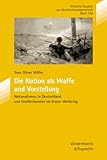
Sven Oliver Müller. Die Nation als Waffe und Vorstellung: Nationalismus in Deutschland und Großbritannien im Ersten Weltkrieg. Göttingen: Vandenhoeck & Ruprecht, 2002. 427 S. EUR 44.00 (gebunden), ISBN 978-3-525-35139-0.
Reviewed by Lisa Swartout (Department of History, Indiana University, South Bend)
Published on H-German (December, 2004)
In his insightful examination of Britain and Germany in World War I, Sven Oliver Müller shows how nationalism could both create a powerful sense of unity as well as deepen divisions within these two societies. The flexibility within nationalism allowed diverse groups to invest it with their own values and claims. He argues: "in both states, the same national language was the source of innumerable misunderstandings" (p. 99).
While historians have justly emphasized the importance of war in state-building, Müller also illustrates how the upheavals of war could undermine the authority of state.[1] The transformative changes in the organization of the state required by war could only be justified with the assertion that the government acted to insure the survival of the nation. In this climate, new groups were able to voice new demands, because everyone within the nation played a role of importance.
Müller draws primarily on newspapers for his source base and sees in them a window to competing understandings of the German and the British nations. He has selected sixteen newspapers and read them systematically for the period between 1914 and 1918; in addition he has consulted a number of other political sources including government and parliamentary papers. Such sources provide a clear perspective on important political debates. Müller utilizes Karl Rohe's divisions of German and British societies into distinct political camps to clarify competing ideas about the nation. For Germany these politische Lager include the Conservatives, [the] Liberals, [the] Social Democrats, and [the] Center. For Britain, they include the Conservatives, [the] Liberals, and [the] Labor [Party].
Müller's first section explores the myth of euphoria and unity at the outbreak of war. His findings are consistent with recent scholarship that levels of enthusiasm for war differed widely across class, ethnic, and religious boundaries. Müller has also found that many Germans and Britons felt simultaneously "fear and enthusiasm, panic and war-readiness" (p. 66). Even at the outbreak of the war the intensification of national sentiments led directly to an increased readiness to identify possible internal threats.
Müller highlights the ways that elites within different political camps emphasized different aspects of their foes. World War I saw a powerful deepening and intensification of nationalist rhetoric and under the strain of total war, Germans and Britons described their enemies as criminals, as parasites, or as a plague, which threatened the existence of the society as a whole. In the German discussions about war conquests, Müller sees a triumph of the völkisch idea as the basis of the nation state (p. 164). This use of the language of criminality and biology--especially as directed against "internal enemies"--only increased in the interwar period.
In the next section, Müller describes resistance against the state and how that resistance was understood by the representatives of different political camps. April 1917 in Germany saw the first great wave of strikes. Demands not only included improvement in working conditions and increases in wages, but also political changes such as the end to censorship and a reform of the suffrage laws. The government responded by sending 40,000 participants in the strike directly to the front. Britain too saw an increase in worker mobilization by the end of the war. The really threatening strikes began in April 1917 with wildcat strikes, and by mid-May 200,000 defense workers struck for three weeks. While the right claimed that the strikers stabbed the nation in the back, the left argued that the real threat to the nation were coal-owners, who were greedily exploiting the workers. Both in Germany and in England the strikes and the crackdown led to a loss of government authority and a diminished effectiveness of appeals to patriotism. Increasingly the leaders of the working class claimed that they spoke for the nation. As a result, both in Germany and Britain, "the categories of 'class' and 'Volk/nation' not only no longer contradicted each other, but in this way of thinking complement each other" (p. 235). The links between class and nation created a powerful rhetoric to battle employers, conservatives, or the government. Here Müller's findings differ from those who see a permanent turn of nationalism to the right after 1878.[2] Müller makes a powerful case for the change in rhetoric between 1914 and 1918; he could have grounded his claims more forcefully with an investigation of the immediate pre-war years.
In his final section, Müller turns to political reform. At the outbreak of war neither Germany nor Britain had universal male suffrage at all levels of government. In Briton, 59 percent of adult men could vote for Parliament. While Germany had universal male suffrage for the Reichstag, the state elections were organized on the basis of a three-class voting system. In Germany a through-going reform stalled, and universal male suffrage was only passed on October 15, 1918. In Müller's view, the delay in achieving reform helped to undermine the legitimacy of the political system. In contrast, in March 1917 Britain passed a universal suffrage law that gave the vote to all men over the age of 21. Müller argues that the "ruling elites" in Germany and Britain had come to opposite conclusions about the relationship between voting rights and stability. In his view the different social and political contexts were decisive: "In Britain the ruling elites--accustomed to parliamentary processes for centuries--showed a striking readiness for reform" (p. 335). In contrast, Müller traces "specifically Prussian-German special conditions [Sonderbedingungen] ... inadaptability, sharp political exclusion of the less-privileged, and relative hostility to reform" (p. 358). These political and social differences helped to shape different visions of the nation in Germany and Britain.
While Müller describes himself as critical of the thesis of Germany's "special path" and while he does find many areas of similarity between Germany and Great Britain, he sees particularly strong differences in the possibilities for reform in suffrage, women's rights, and policies towards ethnic minorities. While he notes the role of social and economic conditions, Müller finds primary explanatory power in different political and cultural traditions in Britain and Germany. His source base of newspaper articles and his focus on political questions might have led forcefully to these kinds of conclusions. For example, surprisingly, Müller does not analyze how transforming the suffrage laws might have shaped electoral outcomes. Furthermore, because of government censorship, newspapers may not have provided an accurate picture of social and economic conditions. Müller's analysis of the women's suffrage debate is typical of his approach and this section displays the strengths and weaknesses of his analysis. He provides interesting information about the views of leading politicians from different political camps. Müller also shows the connections between various political organizations and political parties. Yet his close focus on the questions of policy and of political differences slights other factors that might have played into views about women's suffrage. In the new conditions of war, women's greater sexual freedom was seen to threaten the social order, making women even less suitable for the vote in the view of some. He does not examine ideas about motherhood and the maternal body, which could provide arguments both for those who favored and for those who opposed women's suffrage. Furthermore, with his source base of newspapers and political debates, we learn little about how women themselves felt about suffrage or about the material conditions that might have shaped the suffrage debates. By making connections to other secondary source works, Müller could have deepened his examination of gender, suffrage, and nationalism.[3]
According to Müller, while nationalism is a central part of the literature on World War I, "only seldom does one make the effort to understand specifically what is meant by nationalism" (p. 29). Müller provides an important contribution to that project, especially a deeper understanding of the connections between nationalism, suffrage, citizenship, and some aspects of economic policy. Müller's book is an important accomplishment and will be of great use to historians interested in war and society, suffrage and citizenship, German and British nationalisms, as well as the history of the First World War.
Notes
[1]. Linda Colley, Britons: Forging the Nation (New Haven: Yale University Press, 1992); and Michael Jeismann, Vaterland der Feinde. Studien zum nationalen Feindbegriff und Selbsverständnis (Stuttgart: Klett-Cotta, 1992).
[2]. Heinrich A. Winkler, "Vom linken zum rechten Nationalismus. Der deutsche Nationalismus in der Krise von 1878/79," Geschichte und Gesellschaft 4 (1978), pp. 5-28.
[3]. See in particular Susan R. Grayzel, Women's Identities at War: Gender Motherhood and Politics in Britain and France during the First World War (Chapel Hill: University of North Carolina Press, 1999); Belinda Davis, Home Fires Burning: Food, Politics and Everyday Life in World War I Berlin (Chapel Hill: University of North Carolina Press, 2000), see H-German review at http://www.h-net.org/reviews/showrev.cgi?path=24010974818856; Johanna Albert, Beyond Suffrage: Feminists in War and Peace, 1914-1918 (London: Palgrave Macmillan, 1989); and Karen Hagemann and Stefanie Schueler-Springorum,eds., Home/Front: The Military, War and Gender in Twentieth-Century Germany (Oxford: Berg, 2002), see H-German review at http://www.h-net.org/reviews/showrev.cgi?path=229111085713745.
If there is additional discussion of this review, you may access it through the network, at: https://networks.h-net.org/h-german.
Citation:
Lisa Swartout. Review of Müller, Sven Oliver, Die Nation als Waffe und Vorstellung: Nationalismus in Deutschland und Großbritannien im Ersten Weltkrieg.
H-German, H-Net Reviews.
December, 2004.
URL: http://www.h-net.org/reviews/showrev.php?id=10052
Copyright © 2004 by H-Net, all rights reserved. H-Net permits the redistribution and reprinting of this work for nonprofit, educational purposes, with full and accurate attribution to the author, web location, date of publication, originating list, and H-Net: Humanities & Social Sciences Online. For any other proposed use, contact the Reviews editorial staff at hbooks@mail.h-net.org.

