



Elisabeth Kaske. Bismarcks MissionÖ¤re: Deutsche MilitÖ¤rinstrukteure in China 1884-1890. Wiesbaden: Harrassowitz Verlag, 2002. 293 pp.
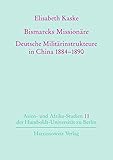
Elisabeth Kaske. Bismarcks Missionäre: Deutsche Militärinstrukteure in China 1884-1890. Wiesbaden: Harrassowitz Verlag, 2002. 293 S. (gebunden), ISBN 978-3-447-04615-2.
Reviewed by Karen Eng (Department of German and Slavic Studies, Tulane University)
Published on H-German (December, 2004)
As part of the growing body of work addressing German-Chinese contact in the nineteenth century, Elisabeth Kaske's Bismarcks Missionäre: Deutsche Militärinstrukteure in China 1884-1890 is a conscientious study of one sparsely explored aspect of German-Chinese interaction, namely a venture undertaken by German military consultants to work in China. This work, a published version of Kaske's dissertation, tracks the consultants' efforts and accomplishments in terms of the premise that while the Germans were ostensibly hired to give guidance to Chinese troops and military activities, their importance really lay in a projection of unity between the German and Chinese governments. German consultants began to work with regularity in China in the 1870s, but they were most actively recruited by Chinese diplomat Li Fengbao in the 1880s, particularly in 1884 and 1885. In these key years, China and France were engaged in a struggle over the territory of Tongking in southern China. Kaske asserts that Li Fengbao's mandate was to draft the German consultants into service to persuade the French that despite German claims to neutrality with respect to the French-Chinese conflict, the Germans were in fact supportive of the Chinese.
Kaske's study, conducted with the support of the Volkswagen corporation under the rubric "German consultants in China" ("Deutsche Berater in China" [p. 11]), bears a secondary point of focus, namely to survey "the success of cultural transfer" resulting from the consultants' venture in China (p. 18). Specifically, Kaske evaluates the movement of "technology, knowledge, and methods" in terms of what she calls "effective cultural transfer." She identifies this as directly determined by the "amount of effort put forth by the recipients" (p. 18). Despite this assertion, Kaske's conclusions on the project's success are drawn from portraits of the Germans, not the Chinese. Kaske's meticulous scholarship closely follows the tribulations, development of qualifications, and fates of the members of the German corps comprising Li Fengbao's contingent of consultants, synthesizing this information into a pronouncement of an overall shortfall in the project's "effective cultural transfer."
The relative lack of wide-reaching effectiveness in the consultants' work in China is examined in terms of two concepts of success. On the first point, where Kaske posits that the Germans were chiefly hired to arouse the ire of the French, it appears that the venture was successful. The French were duly suspicious of the German consultants' work in China, though it is unclear what effect this had on the French-Chinese conflict. With respect to an "effective cultural transfer," Kaske's descriptions of the Germans involved fully acquits them of responsibility for shortcomings, particularly since "none of the members of the 1884 'Mission' could be characterized as an adventurer or charlatan" ("Keiner der Mitglieder der 1884er 'Mission' ist als Abenteuerer oder Hasardeur zu bezeichnen" [p. 198]) and as Kaske observes, the responsibility for the project's "effective cultural transfer" lies most with the Chinese recipients. Kaske leaves open the question of the use value of such a transfer, especially since the first premise of success is so convincingly argued. If indeed this first premise is true, then it would make sense that the inquiry into "effective cultural transfer" would yield few positive results; Li Fengbao and the government he represented were therefore not really receptive nor serious about adopting the consultants' suggestions. This is particularly the case if, as Kaske argues, effective cultural transfer lies with the recipient.
Chapter 8, entitled "'Gastarbeiter'--Ausländerbeschäftigung in China" ("'Guest workers'--the Employment of Foreigners in China"), includes a section that represents Chinese critical of the problems of the "military mission" ("die Probleme der 'Militärmission'"). It is charged that the foreigners are overpaid, obstinate, uncaring of their students, and ineffective in general (p. 193). Kaske counters that the Chinese in comparable situations also were paid well ("Auch chinesieche Fachkräfte konnten auch relativ gut verdienen" [p. 197]), and the Germans' inadequacy was a Chinese perception that stemmed from a lack of understanding German reform measures (p. 199). Kaske's responses to these charges appear too defensive. Rather than responding to these charges by recounting the abilities or qualifications of the Germans, it would add to a more nuanced view of the first premise to contextualize this critique in terms of an inquiry into whether there was dissent from the latent objective of inviting the Germans to undermine the French in the theater of international politics. It is a missed opportunity to probe the question of why the Chinese featured in this part of the study should expect effective training, when the avowed goal of having the consultants in the country was not necessarily for the improvement of Chinese infrastructure. While this section ostensibly represents the "Chinese opinion," it contradicts the claims Kaske makes in her first premise on the project's success.
Translated, the book's title is: Bismarck's Missionaries in China: German Military Consultants in China 1884-1890, and while an inherent identification of the Second Reich with the consultants' activities in China appears, the connection between Bismarck's government and this project specifically, including what Bismarck's role or goals might be, is not articulated. Furthermore, from a cultural studies standpoint, the employment of certain terminologies, including "military mission" or "Militärmission" (referring to the project as a whole) begs some measure of explanation, as does "missionaries" and employment of the term "guest workers" (or Gastarbeiter), when describing the consultants. Kaske limits the applicability of "guest workers" to the German consultants, stating that "the way in which they were 'guest workers,' is that they were in a foreign land, well-paid, and well-treated employees in a modernization process whose progression they would neither determine nor hinder" ("Sie waren im Sinne des Wortes Gastarbeiter in einem fernen Land, hoch bezahlte und gut behandelte Angestellte in einem Modernisierungsprozesses, dessen Gangart sie weder bestimmen noch beschleunigen würden" [p. 192]). Despite these parameters, it seems an incongruous and even ironic application of the term, especially given present-day discourse using the word Gastarbeiter in Germany. This term often expressly represents non-Germans, who are long-term workers, underpaid, not always well-treated, and laboring at the bottom of a hierarchy (not as consultants near the top of it. In addition, unlike Kaske's ineffective consultants, they function as an integral part of the trajectory of modern Germany.
Comprising a considerable part of this study is copious information about living expenses in China, description of the language barriers, and the necessity and difficulty of imposing a German sense of both military hierarchy and general orderliness over the Chinese structures already in place. While not an anthropological study, the trajectory of these consultants' careers (even extending beyond their original service contracts), and more minutely, their day-to-day lives in their new environs are attentively documented. Kaske offers specific information regarding the consultants? various coping mechanisms that enabled them to work despite deep dismay at Li Fengbao's false promises about the living conditions in China, homesickness, and ennui (p. 61). In addition, Kaske's careful research, drawn from period records, diplomatic briefs, and other primary sources, show deft competency in working in Chinese and employing usable parallel terms in German, a task made more difficult because period documents in Chinese are replete with terminologies that constantly shift. The employment of Chinese and German terms is easy to follow and informational.
This informative volume closes with an extensive bibliography and an index that handles the complexity of multilingual keywords very well. A good overview map and helpful notes on topics such as military rank in German and Chinese and the Chinese calendar are included after the last chapter in the book. These are best consulted at the outset of reading this work.
Within the larger body of work covering German-Chinese interaction, Kaske's study is most valuable when read in terms of documenting contact between the two at a time that predates the most active period of German colonial activity. While other studies contextualize the contact Germans had with people abroad in terms of their future consequences, this study adds to a structural sense of international politics and intercultural interaction leading to a closely detailed and relevant view of the German-Chinese past.
If there is additional discussion of this review, you may access it through the network, at: https://networks.h-net.org/h-german.
Citation:
Karen Eng. Review of Elisabeth Kaske, Bismarcks MissionÖ¤re: Deutsche MilitÖ¤rinstrukteure in China 1884-1890 and
Kaske, Elisabeth, Bismarcks Missionäre: Deutsche Militärinstrukteure in China 1884-1890.
H-German, H-Net Reviews.
December, 2004.
URL: http://www.h-net.org/reviews/showrev.php?id=10047
Copyright © 2004 by H-Net, all rights reserved. H-Net permits the redistribution and reprinting of this work for nonprofit, educational purposes, with full and accurate attribution to the author, web location, date of publication, originating list, and H-Net: Humanities & Social Sciences Online. For any other proposed use, contact the Reviews editorial staff at hbooks@mail.h-net.org.

