



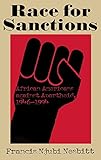
Francis Njubi Nesbitt. Race for Sanctions: African Americans against Apartheid, 1946-1994. Bloomington: Indiana University Press, 2004. xii + 217 pp. $39.95 (cloth), ISBN 978-0-253-34232-4.
Reviewed by Gerald Horne (Department of History, University of Houston)
Published on H-SAfrica (December, 2004)
As the title suggests, this is an account of the role that African Americans in the United States played in the titanic struggle to bring apartheid to its knees. Although there are a few errors (references to "Clements Kaldie", not Kadalie, for example, p. 3), this study is not without value.
Part of this value is that the author acknowledges the role of the left among African Americans--at least in the era before 1955. For those familiar with South Africa, where the Communist Party holds a prominent position, this may seem commonplace. However, on this side of the Atlantic, where the United States was the tip of the spear in a decades-long struggle to bring down the Soviet Union, a historiographic tradition is well-entrenched whereby those of the left are either ignored or their role is distorted.
Certainly, performing this usual mugging would be hard to do in addressing the subject of this book, given the pre-eminent role played by the Council on African Affairs, in which the "Father of Pan-Africanism," W. E. B. Du Bois, and Paul Robeson played leading roles--until this organization was run out of business in the mid-1950s. The author includes an intriguing detail about "Paul Robeson's songs" being "played on a loud speaker" at a mass rally in Johannesburg in April 1952 (p. 18). Rather deftly, the author limns how the role of the left was eclipsed during the height of the Cold War, not least due to state repression. He also demonstrates how, in this vacuum, a "liberal" anti-apartheid grouping arose, the "American Committee on Africa," which touted its anti-communist and non-Communist credentials (p. 23).
The author could have done a more effective job in sketching the dual and linked struggles against white supremacy on both sides of the Atlantic, particularly how the leading black groups in the United States decided to go along with the newly forged anti-communist consensus and, in return, received some concessions, while the African National Congress (ANC) held out steadfastly against this trend--then triumphed in the nation's first democratic elections in 1994, not coincidentally held after the collapse of the Soviet Union.
Similarly, the author makes the error of many writers in claiming that "no white nations were allowed to attend" the epochal Bandung, Indonesia confab of 1955, which in a real sense inaugurated the tendency that became "non-alignment" (p. 26). This statement can only be true if Tito's Yugoslavia is not deemed to be "white."
In writing of the 1960s, the author cogently makes note of the trailblazing 1963 Organization of African Unity (OAU) resolution which expressed "deep concern" about "racial discrimination taken against communities of African origin living outside the continent and particularly the United States of America" (p. 51). This simple reference reminds us of how desperately scholarship needs a comprehensive examination of how Africa sought to influence the United States, which would complement enormously works of the type at hand.
As this book proceeds, certain assertions are made that some readers may feel cry out for further elucidation. For example, in 1973 the justly heralded "African Liberation Day Steering Committee," which sponsored major anti-apartheid and anti-colonial manifestations in a number of U.S. cities, raised "funds" for "UNITA in Angola" (p. 80). Given the latter organization's subsequent trajectory, becoming a Cold War ally of the U.S. ultra-right, some readers may wonder how and why these "funds" were donated. To the author's credit, early on he observes that ideologically the African American community can be divided into "left, nationalist and liberal" segments (p. vii). Though the author is insightful in pointing out the foibles of the latter tendency, less attention is paid to the misadventures of the "nationalist" trend, which was supportive of UNITA, not because of UNITA'a attraction to the U.S. ultra-right but because of their susceptibility to UNITA propaganda which trumpeted its alleged "pro-black" armament, as reflected in their alleged resistance to marrying white women and their supposed resistance to "mulatto" leadership (which were presumed flaws of their MPLA rival in Angola) and, not least, UNITA's ties to Maoist China, which at one time had quite a following among Black Nationalist circles in the United States.
Unfortunately, Nesbitt is not alone in ignoring this trend. There has been an efflorescence of late in the United States of studies of "Black Nationalism" and "Black Power" that either have ignored some of the misdirected flaws of this trend and/or have downplayed the disastrous misalliance with Beijing.
Quite properly, this book addresses the "Sixth Pan African Conference" in Dar es Salaam in 1974 where a conflict arose between "black nationalism" and "socialism." The author writes that "both [Julius] Nyerere and Sekou Toure criticized the 'cultural nationalists'"--who hailed disproportionately from the United States--for "'skin color' politics." This kind of cleavage was also prevalent in Southern Africa as reflected in conflicts between UNITA and MPLA in Angola and the ANC and Pan Africanist Congress in South Africa. The still buried reality of African Americans and the anti-apartheid movement concerns how many "liberal" and mainstream groupings refused to back the ANC because of apprehension about its ties to the South African Communist Party and, as well, how many "nationalist" groupings acted similarly for this reason and also because of objections to the ANC's close ties to the Indian community and the former Soviet Union.
Yet the fact remains that despite the strength of the right-wing in the United States, in the mid-1980s comprehensive anti-apartheid legislation was passed--something that other leading capitalist nations with vibrant left-wing parties and movements were not able to accomplish to a similar extent. Here I think the author underestimates the strength of the left on this issue, particularly in, for example, New York City in the 1970s and 1980s, where I can attest personally that tens of thousands of dollars were raised for the ANC and SWAPO of Namibia and thousands of individuals marched regularly against U.S. policies toward the sub-continent. I can also attest personally that when the then-Communist leader--and South African hero--Chris Hani toured the United States in the early 1990s, he was shepherded not by "nationalists" or "liberals," who still were skittish about Reds even then, but by those of the African American left. Fortunately, such hesitance did not appear to impact Nelson Mandela's triumphant tours of the United States during this same era.
It should not be forgotten that a number of relevant archival collections have yet to be accessioned, which inevitably hampers a study that concludes in 1994. Still, it would have been useful if the author had consulted the Papers of Mervyn Dymally at California State University-Los Angeles and the Papers of former Congressman Charles Diggs at Howard University in Washington, D.C. (Dymally, of Trinidadian origin, was a major player in Congress not only on apartheid but also on policy toward Mobutu's Congo, and Diggs was a pioneer in the anti-apartheid realm.) As it stands, this book relies heavily on journalistic accounts from the New York Times, but given the subject more attention should have been paid to the still thriving African-American press, such as the Los Angeles Sentinel, the New York Amsterdam News, the Philadelphia Tribune, the St. Louis Argus, etc.
Lest a misimpression arise, I should add swiftly that this is a highly important book on an essential topic. Those who seek to comprehend U.S. imperialism and the forces arrayed against it domestically cannot afford to ignore this text, just as those seeking an understanding of how and why apartheid collapsed when it did would do well to study these pages. This book sheds light on ideological conflicts among African Americans--and Africans--that are routinely elided by less discerning scholars; those interested in purely "domestic black" concerns also must pay attention to the author's handiwork. As such, the author merits the fervent congratulations from researchers and students transnationally for producing a book of no small value.
If there is additional discussion of this review, you may access it through the network, at: https://networks.h-net.org/h-safrica.
Citation:
Gerald Horne. Review of Nesbitt, Francis Njubi, Race for Sanctions: African Americans against Apartheid, 1946-1994.
H-SAfrica, H-Net Reviews.
December, 2004.
URL: http://www.h-net.org/reviews/showrev.php?id=10032
Copyright © 2004 by H-Net, all rights reserved. H-Net permits the redistribution and reprinting of this work for nonprofit, educational purposes, with full and accurate attribution to the author, web location, date of publication, originating list, and H-Net: Humanities & Social Sciences Online. For any other proposed use, contact the Reviews editorial staff at hbooks@mail.h-net.org.

