



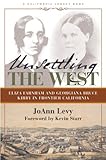
JoAnn Levy. Unsettling the West: Eliza Farnham and Georgiana Bruce Kirby in Frontier California. Santa Clara and Berkeley: Santa Clara University and Heyday Books, 2004. x + 343 pp. $24.95 (paper), ISBN 978-1-890771-83-6.
Reviewed by Deborah Gilbert (American Studies, San Jose State University.)
Published on H-California (November, 2004)
Two Women Reformers in Gold Rush California
Unsettling the West is the double biography of women reformers, Eliza Farnham (1815-1864), born in upstate New York, and Englishwoman Georgiana Bruce Kirby (1818-1887). Embracing the spirit of perfectionism, these women were involved both in reform movements (including prison reform and the women's movement), and lifestyle experiments (including the famous enterprise at Brook Farm, and their own farm in Santa Cruz, California). The two spent a year working together at Sing Sing Prison, a year farming together in Santa Cruz, and a lifetime in correspondence; they were fellow reformers, and as Levy suggests, soul mates.
JoAnn Levy is distinguished as a California historian due to the success of her book, They Saw the Elephant: Women in the California Gold Rush (1990), one of the first monographs to focus on the experience of women in the western United States. Levy has also written two novels, Daughter of Joy: A Novel of Gold Rush California (1998) and For California's Gold: A Novel (2000). Unsettling the West is in the California Legacy Book series, published jointly by the best regionalist publishing house in California, Heyday Books, and Santa Clara University. The series includes re-editions of important books in California history and literature (including books by Carey McWilliams, Louise Amelia Knapp Smith Clappe a.k.a. Dame Shirley, Josiah Royce, and Bayard Taylor) as well as new works.
Eliza Farnham and Georgiana Bruce Kirby struggled to survive both materially and morally. Farnham had a hard luck life while Kirby was more of an intentional adventurer. Farnham's reform work was her career and a matter of financial necessity throughout her life, while Kirby, in her mid-thirties, married a man who was able to support her financially.
In many ways, Farnham and Kirby are both unique and surprising. Farnham, especially, expressed her many opinions, boldly and publicly, and her reform efforts were often ahead of the times (like teaching women prisoners to read and supplying them with an array of books). Yet in other ways, these women were quite predictable. For example, in her book California In-doors and Out (1856), Farnham laments the prevalence of drinking, gambling and swearing in California, and romantically recalls California's Mexican era. While this pious brand of morality is all too familiar to those who study nineteenth century reform movements, Farnham and Kirby's reformism usually pushed the envelope, and often put them in the center of attention, good and bad. Levy begins her book with an account of one of Farnham's innovative efforts. After reading in Eastern papers about the rough and tumble state of affairs in gold rush California, Farnham went directly to work on a plan to bring a boatload of good women to civilize California. (Perhaps William Wellman was inspired by Farnham's scheme when he made his 1951 film Westward the Women). Farnham might be best understood as a practitioner of influence.
Farnham lived in California (and primarily in Santa Cruz) from 1849 to 1856, and Kirby lived there from 1850 to the end of her life in 1887. In the 1850s, California was in the thralls of expansionism. California Indians and Californios were being dispossessed of their lands, California Indians were dying due to disease, starvation and settler violence, nature was under rapid transformation, and by 1860 the railroad monopoly (that plagued the state through the Progressive Era) was on the rise. Why, then, in their accounts of life in California do Farnham and Kirby never mention the above historical circumstances?
The nineteenth century reform movements can be explained, in large measure, by insecurities brought on by industrialism, immigration and expansionism. With a population acutely divided along the lines of race, class, religion, and region, one of the most pressing questions in the nineteenth century was how to contain social and economic tension and reconcile competing visions. Though men distinguished themselves as reformers, the reform movement certainly meant more for women as they had many fewer opportunities to enter the public sphere due to the limitations inscribed in their role as domestic saints. In that it allowed women to expand their roles, the reform movement was a kind of vehicle for the Cult of True Womanhood. Women could put their civilizing prowess to work on workers and immigrants, African Americans, Native Americans and others. Hence the women's reform movements served to mediate social and economic tensions during this unprecedented period of growth.
In recent years, many scholars have suggested that women reformers were complicit victims, both colonized and colonizing. They worked to join others up to middle-class, American society as it were. Farnham and Kirby, however, did not see their reform efforts as buttressing imperialism, nor does Levy see their work in that way. Levy champions their work, and her account is absolutely compelling, though traditional vis-a-vis contemporary work in the field.
To place Levy's work in context, I will briefly narrate the history of scholarship pertaining to women in the West. In the 1970s, the second wave of feminism started a spate of salvage history and republications pertaining to women in the United States. Furthermore, California Studies--like other interdisciplinary, identity-based academic fields--grew up in the wake of the identity movements of the 50s and 60s. Ann Douglas invigorated the field with her 1977 book The Feminization of American Culture, and others like Jill Kerr Conway, Jane Tompkins, Annette Kolodny, Lillian Schlissel, and Sandra Myres blazed the way in the 80s [1]. Some early salvage history had inadequacies including generalizations and over-simplifications, and race- and class-based silences and gaps, but corrective scholarship filled in the gaps continually. An important shift occurred in the 80s, as scholars rejected women's "receptacle of culture" status and recast them as participants in history. Furthermore, in the 1990s, California regionalism increasingly integrated with Marxist influenced approaches (e.g. Cultural Studies).
Most scholarship pertaining to women in the West fits into one of three categories: 1) traditional scholarship that prioritizes the experience and perceptions of white, middle-class women (like Myres and Kolodny); 2) "hidden order" type scholarship that pays special attention to issues of imperialism, and articulations of race and class (Glenda Riley, Ida Rae Egli, Patricia Limerick, Judy Yung); 3) Marxist-influenced scholarship (Mendez Gonzalez, Rosaura Sanchez and Beatrice Pita). Unsettling the West is in line with traditional scholarship. Levy's research is more like that of Kevin Starr (who introduces the book) than Mike Davis. Her approach is in the school of celebrating progress, rather than pointing out the ways in which nineteenth century women reformers acted as agents of U.S. imperialism. Levy, for instance, does not pause to consider the way in which Mr. Farnham obtained the Santa Cruz lands that his widow later farmed (her husband bought the land at a discount rate from ex-Mission Indians), or the way Farnham describes her Indian employee as proud and lazy. This issue is especially interesting in light of the fact that Farnham later became interested, albeit briefly, in the so-called Indian problem.
What I most appreciate about Unsettling the West is its unique perspective on the years 1849-1854 in California. One usually hears about men and gold, and this book is about neither. Furthermore, the book is very readable due to Levy's easy transitions, and because she consistently glosses relevant historical and cultural issues like the Worcester convention, the placement of California's capitol, the sinking of the Central America, and the establishment of mental institutions and the prison system in California.
Notes
[1]. Relevant scholarship pertaining to women in U.S. history (listed chronologically by publication date):
Brownlee, W. Elliot, and Mary M. Brownlee. Women in the American Economy: A Documentary History, 1675 to 1929. New Haven: Yale UP, 1976.
Wertheimer, Barbara Mayer. We Were There: The Story of Working Women in America. New York: Pantheon Books, 1977.
Douglas, Ann. The Feminization of American Culture. New York: Avon Books, 1977.
Conway, Jill Kerr. The Female Experience in Eighteenth- and Nineteenth-Century America: A Guide to the History of American Women. New York: Garland Pub., 1982.
Kolodny, Annette. The Land Before Her: Fantasy and Experience of the American Frontiers, 1630-1860. Chapel Hill: The University of North Carolina Press, 1984.
Tompkins, Jane. Sensational Designs: The Cultural Work of American Fiction 1790-1860. New York: Oxford University Press, 1985.
Relevant scholarship pertaining to women in the West (listed chronologically by publication date):
Sprague, William Forrest. Women and the West: A Short Social History. New York: Arno Press, 1940.
"California Women's History Sources." Women's History Sources: A Guide to Archives and Manuscript Collections in the United States. Ed. Andrea Hinding. New York: Bowker, 1979.
Jeffrey, Julie Roy. Frontier Women: "Civilizing" the West? 1840-1880. New York: Hill and Wang, 1998. (First published in 1979.)
Schlissel, Lillian. Women's Diaries of the Westward Journey. New York: Schocken Books, 1981.
Myres, Sandra. Westering Women and the Frontier Experience 1800-1915. Albuquerque: University of New Mexico Press, 1982.
Women and Western American Literature. Eds. Helen Stauffer and Susan J. Rosowski. Troy, New York: The Whitston Publishing Co., 1982.
Riley, Glenda. Women and Indians on the Frontier 1825-1915. Albuquerque: University of New Mexico Press, 1984.
"Women." The Frontier Experience: A Reader's Guide to the Life and Literature of the American West. Eds. Jon Tuska and Vicki Piekarski. Jefferson, N.C.: McFarland, 1984.
The Women's West. Eds. Susan Armitage and Elizabeth Jameson. Norman Oklahoma: The University of Oklahoma Press, 1987.
Jensen, Joan M. and Gloria Ricci Lothrop. California Women: A History. San Francisco: Boyd & Fraser Pub. Co., 1987.
Western Women: Their Lands, Their Lives. Eds. Lillian Schlissel, Vicki L. Ruiz and Janice Monk. Albuquerque: University of New Mexico Press, 1988.
Levy, JoAnn. They Saw the Elephant: Women in the California Gold Rush. Archon Books, 1990.
Bennion, Sherilyn Cox. Equal to the Occasion: Women Editors of the Nineteenth-Century West. Reno: University of Nevada Press, 1990.
So Much to be Done: Women Settlers on the Mining and Ranching Frontier. Eds. Ruth B. Moynihan, Susan Armitage and Christiane Fischer Dichamp. Lincoln: University of Nebraska Press, 1990.
Locke, Mary Lou. "Out of the Shadows and into the Western Sun: Working Women of the Late Nineteenth-Century Urban Far West." Journal of Urban History 16 (1990): 175-204.
Egli, Ida Rae. No Rooms of their Own: Women Writers of Early California. Berkeley: Heyday Books, 1992.
Yung, Judy. Unbound Feet: A Social History of Chinese Women in San Francisco. Berkeley: UC Press, 1995.
If there is additional discussion of this review, you may access it through the network, at: https://networks.h-net.org/h-california.
Citation:
Deborah Gilbert. Review of Levy, JoAnn, Unsettling the West: Eliza Farnham and Georgiana Bruce Kirby in Frontier California.
H-California, H-Net Reviews.
November, 2004.
URL: http://www.h-net.org/reviews/showrev.php?id=10020
Copyright © 2004 by H-Net, all rights reserved. H-Net permits the redistribution and reprinting of this work for nonprofit, educational purposes, with full and accurate attribution to the author, web location, date of publication, originating list, and H-Net: Humanities & Social Sciences Online. For any other proposed use, contact the Reviews editorial staff at hbooks@mail.h-net.org.

